
It said New Delhi increased its purchase of foreign exchange over the first three quarters of 2017 which does not appear necessary.

Reserve Bank of India Governor Shaktikanta Das on Friday said the country's economy is an island of stability despite two Black Swan events and multiple shocks. "In an ocean of high turbulence and uncertainty, Indian economy is an island of macroeconomic and financial stability," Das told reporters during the post policy press conference. He said the financial stability, macroeconomic stability and resilience of growth is being witnessed despite two Black Swan events happening one after the other and multiple shocks.

'The Budget must be pro-growth, focusing on infrastructure creation while also managing the fiscal deficit.'

The moves by the RBI, announced late on Wednesday, should increase supplies of gold and brighten the earnings outlook for jewellery makers after the government took tough measures to curb imports last year, analysts said.

September import growth was the second lowest this fiscal year, after the April growth figures of 4.6 per cent, bringing the trade deficit down to $13.98 billion

The official said there are both challenges and opportunities for India as many of its competitor countries in exports, such as China Vietnam, Bangladesh, Cambodia and Thailand, face higher duties.

The new government will face four big challenges -- subdued growth, the fiscal and current account deficits and sticky inflation, RBI Governor Raghuram Rajan said.

Gold imports, which have a bearing on the current account deficit, declined 47.42 per cent to $9.28 billion during April-October due to fall in demand in the wake of the COVID-19 pandemic, according to data from the commerce ministry. Imports of the yellow metal stood at $17.64 billion in the corresponding period of 2019-20. The imports, however, recorded a growth of about 36 per cent in October.

'Each state is unique, but when it comes to finance, the fundamentals cannot be different.'

The current capital flight is a short-term phenomenon, the agency said.

Weighed down by a weak rupee, the Reserve Bank on Tuesday chose to keep all key interest rates unchanged and asked the government to take urgent steps to reign in the high current account deficit.

Inflation to peak in the current quarter within tolerance band, moderating in the second half of next fiscal, says central bank.
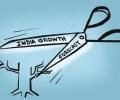
India's real GDP growth will decline marginally to 6.3 per cent in 2024 from the 6.4 per cent estimated for 2023, an American brokerage firm said on Monday. The next calendar year will be of two halves, wherein the government spending before the upcoming General Elections will be the key driver for growth, while after the elections, it will be the re-acceleration in investment growth, especially from the private sector, Goldman Sachs said in a report. From a fiscal year perspective, the brokerage said it expects growth to accelerate to 6.5 per cent for FY25 from the 6.2 per cent it has projected for the ongoing FY24, it added.

Fitch Ratings says in a report published on Thursday that the spillover effects of a weaker rupee have not significantly hurt India's creditworthiness, and hence would not trigger any rating action as this point.

The country's exports rose by 48.34 per cent to $32.5 billion on account of healthy growth in shipments of petroleum products, gems and jewellery, and chemicals, leather and marine goods, according to the data released by the Commerce Ministry on Thursday. Imports in June too rose by 98.31 per cent to $41.87 billion, leaving a trade deficit of $9.37 billion as against a trade surplus of $0.79 billion in the same month last year. During April-June 2021, the exports increased by 85.88 per cent to $95.39 billion.

Reserve Bank of India Governor D Subbarao has said India, being a current account-deficit country, is more vulnerable to sudden reversals in capital flows and short-term overseas portfolio money than nations which have a current account surplus.

Fiscal deficit would be brought down to below 4.5 per cent by 2025-26, Finance Minister Nirmala Sitharaman said on Wednesday. She also said that tax receipts for the next fiscal are budgeted at Rs 23.3 lakh crore and states would be allowed 3.5 per cent of GDP as fiscal deficit. To finance the fiscal deficit in 2023-24, net market borrowing from dated securities is estimated at Rs 11.8 lakh crore, Sitharaman said while presenting the Union Budget for 2023-24 in the Lok Sabha.

The economy is likely to grow at about 5.6 per cent in 2014-15 and fiscal and current account deficits no longer pose a threat to macroeconomic stability, India Ratings said on Friday.

The trade gap was $11.66 billion in December 2015 while in September 2015 it stood at $10.16 billion

Pakistan was "drowning" in debt and it was the new government's job to "sail this ship ashore," Prime Minister Shehbaz Sharif said on Wednesday.

RBI's projection of retail inflation at 6.8 per cent in the current fiscal is neither too high to deter private consumption, nor so low as to weaken inducement to invest, the Economic Survey said on Tuesday. However, entrenched inflation may prolong the tightening cycle and therefore, borrowing costs may stay 'higher for longer', it said. The Economic Survey 2022-23 was tabled in Parliament by Finance Minister Nirmala Sitharaman.

The Centre's fiscal deficit at the end of February stood at 82.7 per cent of the full year budget target, mainly on account of higher expenditure, according to government data released on Thursday. In the last financial year, the fiscal deficit or gap between the expenditure and revenue was 76 per cent of the Revised Estiamate (RE) of 2020-21. In actual terms, the deficit stood at Rs 13,16,595 crore at the end of February this year, as per the data released by the Controller General of Accounts (CGA).

Plannning Commission projects economy to grow up to 7.9% in 12th Plan against earlier estimate of 8%.
.jpg)
Narrowing of the current account deficit will help arrest depreciation of the rupee and ease inflation concerns, industry groups said.

The much-talked-about sale of Ambuja Cement and ACC by Holcim Group will see the single-biggest outflow of foreign capital from the country if the two cement firms are acquired by Indian investors. The deal, valued at nearly $10.35 billion, will put in the shade Cairn Energy Plc's exit from India in 2010, when it sold Cairn India to Vedanta Group for $4.48 billion. According to various reports, big business groups such as AV Birla, JSW Group, and Adani Group are in the fray to acquire Holcim's assets in India.

India's economic growth slowed to near two-year low of 5.4 per cent in the July-September quarter of this fiscal due to poor performance of manufacturing and mining sectors, but the country continued to remain the fastest-growing large economy, data showed on Friday. The gross domestic product (GDP) had expanded by 8.1 per cent in the July-September quarter of 2023-24 fiscal. The previous low level of GDP growth at 4.3 per cent was recorded in the third quarter (October-December 2022) of financial year 2022-23.

The Prime Ministry's Economic Advisory Council Chairman also said fiscal deficit is a concern too and suggested raising domestic oil prices to restrict it to the budget target of 4.8 per cent of the gross domestic product in this fiscal.
Fix agriculture to target food inflation, create labour-intensive manufacturing to target the current account deficit, and fiscal restructuring can target the infrastructure deficit.

In the global context India is looking 'very special'.

Latest data clearly showed that the current account deficit stood at a record level and the economic growth was stuck at a three year-low in the second quarter of the current financial year.

It's the beginning of a rate reduction cycle

Gold imports, which have a bearing on the current account deficit (CAD), plunged 57 per cent to USD 6.8 billion (around Rs 50,658 crore) during the first half of this fiscal amid a slump in demand due to the Covid-19 pandemic, showed data by the commerce ministry.

The rupee has been under immense pressure due to a host of reasons including soaring crude oil prices, sustained foreign fund outflows and widening current account deficit.
Besides, a higher opening in the domestic equity market and strengthening of the euro against the dollar overseas supported the local currency, forex dealers said.
Jewellers are also focusing on designs to attract customers.

India's current account deficit is expected to deteriorate in the current fiscal on account of costlier imports and tepid merchandise exports, according to the Finance Ministry's monthly economic review. The review released on Thursday by the ministry also said that global headwinds would continue to pose a downside risk to growth as crude oil and edibles, which have driven inflation in India, remain major imported components in the consumption basket. For the present, it said, "their global prices have softened, as fears of recession have dampened prices somewhat. This would weaken inflationary pressures in India and rein in inflation."
The sharp and sudden fall in the exchange rate of the Indian currency in relation to the American greenback has taken many by surprise.
.jpg)
The basis of Ind-Ra's expectation of INR appreciation is based on economic developments in the last one to two months of this fiscal and the likely developments in the remaining months.
India's external debt rose by almost 13 per cent to $390 billion in 2012-13, mainly due to an increase in short-term trade credit and external commercial borrowings amid a high current account deficit.

He also suggested reducing interest rates would help stimulate growth.
 © 2026 Rediff.com - Advertise with us - Disclaimer - Privacy Policy - Sitemap - Feedback - About us - Terms of use - Grievances